Israel Defense Forces
Here There Is No WhyIsrael Defense Forces is the military institution through which the novel examines how national defense, occupation, secrecy, and violence enter ordinary relationships. It is present in the rifle cleaned on a cheap Persian carpet, in the patrols around Bethlehem and the West Bank, in the soldiers stationed near massacres, and in the memories that continue to govern families long after formal service ends. The organization’s decisive significance lies in the gap between its stated rules of necessary force and the human consequences of applying those rules amid uncertainty.
Structure and Service
Israel Defense Forces appears first through Charlie, an American who made Aliyah, completed his army service, and at twenty-one began his first year of college. His military identity separates him from Judah even though both grew up in the American Midwest and share baseball, basketball, rock music, and beer. Charlie socializes mainly with fellow new immigrants, while Judah spends time with less permanent Americans; nevertheless, the two roommates become fond of one another. Their shared apartment makes military power intimate rather than distant: Charlie keeps an Uzi beneath his bed, disassembles and cleans it on the Persian carpet, and then reassembles it for inspection.
Charlie’s reserve duty reveals the army’s mixture of secrecy and routine. He reports at seven in the morning for his first reserve assignment and says that the destination is near Bethlehem, eventually naming Bethlehem while joking that Judah should not tell his supposed spymasters. His repeated warnings that he cannot discuss army matters blur genuine military confidentiality with self-conscious performance. The location also shows how the army’s operational world is organized through controlled movement and contested space: the assignment is not in Lebanon, but it is very near the West Bank city, where military patrols form part of everyday life.
The organization’s larger wartime context is more serious than Charlie’s teasing manner suggests. Israel Defense Forces invaded Southern Lebanon almost three years into Charlie’s service. His unit spent the first week after the incursion training in the Negev with new weapons, then patrolled Ramallah and Nablus, two comparatively quiet West Bank cities. Charlie never faced combat, and his service ended the following week. His experience therefore contrasts sharply with the scale of the war: while thousands of young men fought Lebanese militias and Palestinian armed groups, his own exposure to combat was largely represented by the weapon under his bed and by conversations about what the army was doing elsewhere.
Weapons, Rules, and Moral Boundaries
Charlie states a military rule in stark terms: guns are not toys, especially in Lebanon, and they may be used only when absolutely necessary. The principle resembles a compact code of restraint, but the novel places it under pressure by showing how quickly the distinction between defense and harm can collapse. Charlie says that if he had been sent to Lebanon, he would have found a way to avoid it, and his reaction to the massacres at Sabra and Chatila is equally direct: Israel should leave. His position does not erase his attachment to the army or to Israel, but it refuses to treat military service as an automatic moral vindication.
The weapon is also a material reminder of the difference between civilian and military consciousness. Judah cannot imagine being required to decide whether to fire a gun and cannot imagine holding even Charlie’s unloaded weapon. Charlie, by contrast, understands the gun as an object governed by sacred necessity. The Uzi’s presence under the bed turns the roommate’s domestic space into a miniature military environment, while its cleaning ritual makes institutional discipline visible through ordinary gestures: components are wiped, oils arranged, and the weapon carefully put back together.
The army’s rules become more troubling in Yoav Lerner’s case. Charlie tells Judah that Yoav, Chaim Lerner’s son, suffered what was described as a breakdown in the Israeli zone of Southern Lebanon and shot two ten-year-old children. The account circulated as a notorious case among soldiers serving in Lebanon. Possible justifications are offered—children might carry bombs, conceal pistols, or throw stones—but Yoav’s own position is that he does not remember the shooting. The explanation of a breakdown, or of a soldier simply snapping, leaves unresolved the question the organization’s rules are meant to answer: how much certainty is required before force becomes permissible, and who bears responsibility when perception fails?
War, Proximity, and Collective Responsibility
Israel Defense Forces is implicated not only through direct acts of shooting but also through the structure of military proximity. At the time of the Sabra and Chatila massacre, Chaim Lerner’s account places his unit a few kilometers south of the refugee camps. The soldiers heard shots, Arabic commands from loudspeakers, and screams that sounded like children. The next day they learned that hundreds of civilians had been murdered, including children, mothers, and babies. Chaim says that the soldiers did nothing: he remained at his post monitoring radio transmissions, touched his rifle while waiting for orders, and heard no order to intervene.
The account makes nonintervention an organized condition rather than a simple personal omission. Thousands of soldiers stood idle while allied Christian Lebanese forces killed civilians. When the shooting stopped, the army eventually received orders to enter Chatila in jeeps and half-tracks; roughly two hundred and fifty soldiers, perhaps fewer, moved in. The sequence places the army between direct perpetration and passive observation, showing how command structures can make waiting, listening, and not acting into consequential forms of participation. The question is not only who fired the shots, but who was positioned to hear them, who awaited authorization, and what institutional silence permitted the killing to continue.
The massacre becomes a permanent wound inside the Lerner family. Chaim and Zehava argue about politics, but neither truly believes the positions being performed; the argument is displaced grief and fear over their son Yoav, who is stationed somewhere in Lebanon. The word Lebanon, and especially the names Sabra and Chatila, repeatedly summons Yoav’s presence. Military deployment therefore reorganizes family life even when the soldier’s exact location is unknown. It turns political debate into domestic combat and makes the army’s distant operations emotionally immediate.
Soldiers, Settlements, and Spatial Power
The novel also presents Israel Defense Forces as the force behind a geography in which civilian neighborhoods, settlements, refugee camps, and military zones overlap without becoming equivalent. Chaim travels with Judah to Pisgat David to speak with West Bank religious settlers. Judah expects tents, guard towers, patrols, and barbed wire, but finds a brightly lettered welcome sign, large red-roofed houses, garages, lawns, and children playing American football. The settlement resembles an American suburb more than the Jerusalem Judah knows. Its apparent normality depends on a broader military and political system that makes contested space habitable for one population while remaining inseparable from surveillance, patrol, and exclusion.
This spatial contrast is sharpened by the story of Kamal, who lives in Dheisheh Refugee Camp less than twenty minutes from Hod HaSharon. Kamal describes a mission to bomb a Sbarro restaurant site, connecting his intended violence to his grandparents’ expulsion from an Arab village during the Nakba and to his grandfather’s ruined medical career as a refugee. His testimony does not make the bombing permissible, but it places militant action within the same landscape of displacement, military control, and inherited grievance that surrounds the army. The organization is thus part of a spatial order in which a settlement can look suburban, a refugee camp can remain close by, and movement between them carries historical and political meaning.
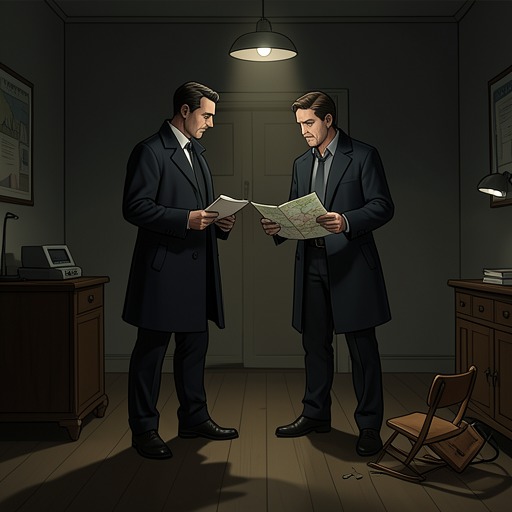
The later peace negotiations preserve this geography as a problem. During secret London meetings, Israel offers roughly 95 percent of the West Bank, while the Palestinian negotiators insist on the whole territory with minor border adjustments for most Jewish settlers. Judah glimpses maps showing Pisgat David on the Palestinian side in both versions. Charlie arranges Judah’s access to the talks but remains in Israel in case a new terrorist wave breaks out. Even while diplomacy attempts to redraw boundaries, military readiness remains the condition surrounding the negotiations. The army’s role is therefore not suspended by peace language; it continues to define the risks, limits, and urgency of political compromise.
Aftermath and Narrative Significance
Israel Defense Forces leaves behind consequences that outlast enlistment. Charlie becomes a college student after discharge, later hopes to become an Israeli police officer, and eventually dies in a terrorist bombing outside the Russian Compound that also kills the head of Israel’s police homicide division. His death extends the novel’s chain from military service to policing, terrorism, and public security. The institution does not disappear when a soldier leaves it; its conflicts migrate into civilian professions, friendships, political arguments, and investigative work.
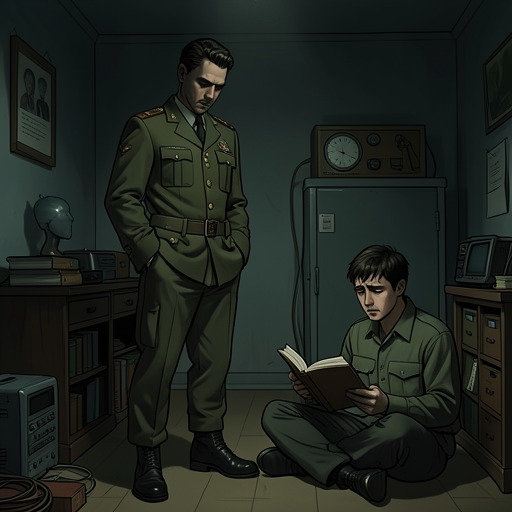
Yoav’s story gives the army’s legacy its most intimate form. He is not presented merely as an individual criminal or as an abstract symbol of military wrongdoing. His shooting of the two boys is surrounded by weapons training, parental instructions, rules of self-defense, combat confusion, and the inherited trauma of Chaim’s Holocaust memories. Before Yoav entered the army, his parents told him that if his life seemed threatened, even without complete certainty, he should shoot and deal with the consequences afterward. That advice converts uncertainty into a command to survive, but Yoav’s later act exposes the cost of such a threshold when children are misrecognized as armed enemies.
Chaim interprets Yoav’s action through the catastrophic moral vocabulary of the Holocaust. He imagines Israel as the stronger power and fears that his own son has become the child-killing figure in his recurring nightmare of a Nazi colonel in the Israeli army. The comparison is not offered as a legal classification of Israel Defense Forces, but as the language of a survivor who experiences the army’s violence as an inversion of Jewish historical suffering. His eventual suicide, as presented through Yoav’s account, is linked to the belief that his son’s act made the nightmare real.
The organization’s public and private responsibilities are also shaped by concealment. Zehava’s political ambitions, her rise as a leading opposition figure, and her later negotiation with the Palestinian Authority make truth a political resource. She argues that exposing the old scandal could destroy an extraordinary opportunity for peace, while Judah accepts Charlie’s arrangement and writes Chaim’s death as an unresolved mystery. The military past is consequently not simply remembered or prosecuted; it is edited, deferred, and traded against national reputation and diplomatic possibility. The novel’s final moral pressure comes from this unresolved exchange: military secrecy may protect operations, political secrecy may protect peace efforts, but both can also preserve the conditions under which victims, families, and the public remain without a complete account.